
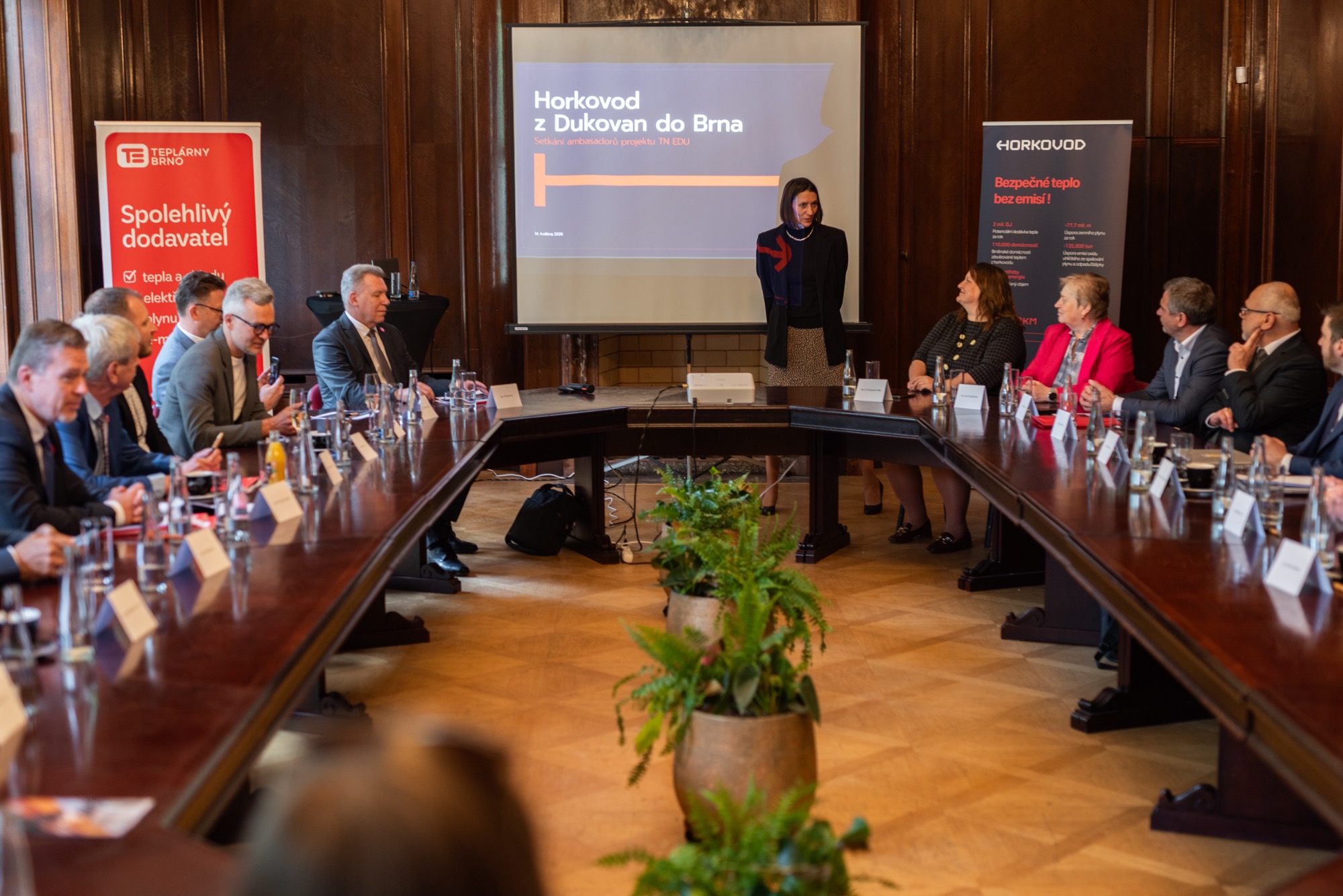
Brno, 14 May 2026 – At the meeting of ambassadors of the Dukovany-Brno hot water pipeline project, Teplárny Brno presented the current state of the preparations for one of the most significant energy infrastructure projects in the Czech Republic. The meeting, attended by representatives of the city of Brno and leading experts in the field of energy, security and financing, confirmed the importance of the project for the future of the district heating sector and energy security of Brno. In addition, the hot water pipeline received further strong support. The team of ambassadors has recently welcomed Members of the European Parliament Ondřej Knotek and Tomáš Kubín, Member of Parliament Filip Turek, and Kamil Števanka representing the Ministry of Industry and Trade.

Project Continues Key Preparations
“The implementation of the Dukovany-Brno hot water pipeline is taking clearer shape. We have reached important milestones in project preparation, set up a management system and continue to take the next steps so that the project is completed on schedule,” says Petr Fajmon, CEO of Teplárny Brno.
In the section between the municipality of Dukovany and the Brno district of Bosonohy (non-urban area), where the hot water pipeline crosses the cadastral territories of 14 municipalities, Teplárny has completed the first phase of the project documentation and is now finalizing the route approval process for the pipeline. At the same time, other design works are progressing, along with the preparation of tenders for key parts of the project. In the territory of the city of Brno (urban area), Teplárny has initiated design works on individual sections of the future route and started with follow-up surveys. In addition, preparations for property rights settlement are also underway.
Project financing is another crucial part of the preparations. The hot water pipeline is one of the country’s strategic energy projects, as well as one of the largest investments in the modernization of the district heating sector in the Czech Republic. Once completed, it will significantly reduce Brno’s dependence on natural gas.
New Ambassadors
Teplárny Brno has recently expanded the project’s team of ambassadors. Joining the expert team are Members of the European Parliament Ondřej Knotek and Tomáš Kubín (both representing ANO), alongside Filip Turek, Member of Parliament and Government Commissioner for Climate Policy and the Green Deal (Motorists), and Kamil Števanka representing the Ministry of Industry and Trade.
“The support of our ambassadors is important to us also because it helps foster both expert and public debate on the future of modern energy. I very much appreciate their support, which confirms the relevance of the project not only for Brno but also in the wider context of energy stability,” said Jiří Herman, Chairman of the Board of Directors of Teplárny Brno.
The ambassadors provide expert oversight of the project. They include leading experts in European legislation, energy industry, finance, cybersecurity and project management, and external advisers in the fields of energy, finance and security management.
“Brno is definitively joining the family of cities that have turned science fiction into reality by using nuclear energy to provide comfortable and clean heating for their citizens. The project is becoming another European benchmark for the clean energy of the future, showing that if we respect economic rules and physical laws, we can actually solve the problems of the 21st-century energy sector,” says MEP Tomáš Kubín, who also spoke today at the meeting of project ambassadors in Brno.
Benefits of the Dukovany-Brno Hot Water Pipeline
The Dukovany-Brno hot water pipeline project will connect the Dukovany Nuclear Power Plant with Brno’s district heating network. When completed, it will cover up to half of the city’s heat consumption and provide a stable, low-emission and price-predictable heat source for more than 110,000 households. The project will also significantly help to decarbonize the district heating sector, reduce the consumption of natural gas and enhance the region’s energy self-sufficiency.